Cookies on oxfam

We use cookies to ensure that you have the best experience on our website. If you continue browsing, we’ll assume that you are happy to receive all our cookies. You can change your cookie settings at any time. Find out more Close

RSS updates

Subscribe to our feeds for the latest Policy & Practice updates.

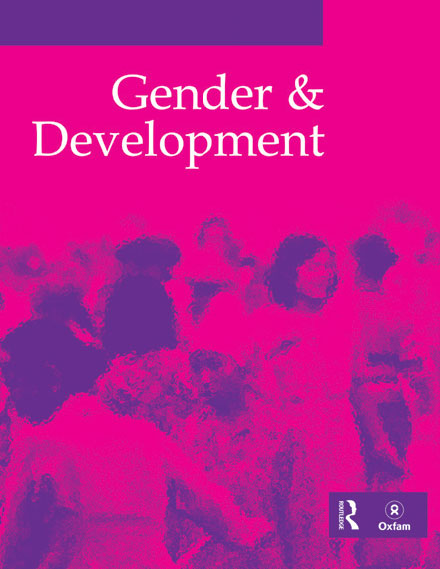
Gender & Development

Women collecting water from the completed Oxfam pond, Rajasthan, India. Shailan Parker/Oxfam

At a glance

Gender & Development is the only journal in the world to focus on international gender and development issues.

Overview

Gender & Development is the only journal in the world to focus on international gender and development issues, exploring the connections between gender and development initiatives, and feminist perspectives.

Established in 1993, the journal is a forum for all involved in development initiatives: policy-makers and practitioners, researchers both inside and outside academia, and activists. It aims to debate best practice and new ideas, and to make the links between theoretical and practical gender and development work.
Gender & Development appears three times a year, in March, July, and November. Each collection of materials focuses on a current 'hot topic'. A particular feature of the project is the high level of contributions from practitioners, and from the global South. We have users in over 90 countries.

Recent issues:

Forthcoming issues:

Volume 21

  • March 2013: Special Issue from the AWID 2012 Forum
  • July 2013: Working with men
  • November 2013: Feminist solidarity and collective action

Volume 22

  • March 2014: Education
  • July 2014: The care economy
  • November 2014: After the Millennium Development Goals


Contribute to the journal


Contributions are welcome from all involved in development initiatives: policy-makers and practitioners, researchers both inside and outside academia, and feminist activists. For more information on contributing as well as all the latest news, visit the Gender & Development website:  www.genderanddevelopment.org.

The Working in Gender and Development book series (WiGaD) brings together themed selections of the best articles from Gender & Development, and other Oxfam publications repackaged in book format.

Titles in this series present the theory and practice of gender-oriented development in a way that records experience, describes good practice, and shares information about resources. As such, they contribute to and review current thinking on the gender dimensions of particular development and relief issues.

You can buy print editions of this book series at the Development Bookshop.

Gender & Development Learning Projects

2011 -  Beyond Gender Mainstreaming learning project in partnership with the UK Gender and Development Network (GADN)

Read Caroline Sweetman's blog about the event.

Download the synthesis document resulting from this online discussion.

View videos from the event at the Gender & Development website.

Gender & Development is published for Oxfam by Routledge/Taylor & Francis as a print and electronic journal, available by subscription. To find out more about how to subscribe, please visit the Taylor & Francis website.

Content is also available free of charge from the Gender & Development website: www.genderanddevelopment.org. Individual articles can be downloaded from the site for the use of development practitioners, policymakers and students interested in a particular topic.

The website also offers guidance for contributors, upcoming themes and links to other materials, as well as information on our Beyond Gender Mainstreaming Learning Project. Readers are invited to participate in an online discussion related to this project via the Eldis communities: http://community.eldis.org/bgm.

In addition, all Gender & Development articles are available to download free of charge from this website (Oxfam Policy & Practice).

Gender & Development is published for Oxfam by Routledge/Taylor & Francis as a print and electronic journal, available by subscription. To find out more about how to subscribe, please visit the Taylor & Francis website.

Content is also available free of charge from the Gender & Development website: www.genderanddevelopment.org. Individual articles can be downloaded from the site for the use of development practitioners, policymakers and students interested in a particular topic.

The website also offers guidance for contributors, upcoming themes and links to other materials, as well as information on our Beyond Gender Mainstreaming Learning Project. Readers are invited to participate in an online discussion related to this project via the Eldis communities: http://community.eldis.org/bgm.

In addition, all Gender & Development articles are available to download free of charge from this website.